
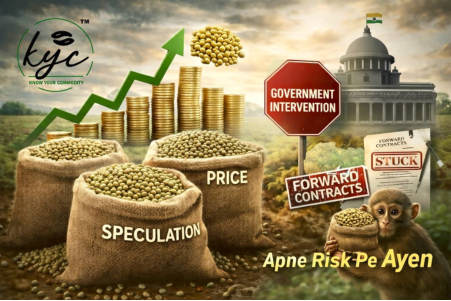
When food commodities start behaving like speculative assets, government intervention is not optional—it becomes essential. Pigeon peas (Tur/Arhar) today are a classic case where narrative has disconnected from numbers. Let’s ground this discussion in facts. India’s 2025–26 supply position is comfortable, not tight. Production: ~2.7 MMT Imports: ~1.0 MMT Opening stock: ~0.71 MMT Total availability: ~4.41 MMT Against expected consumption of ~3.90 MMT, ending stocks are projected at ~0.47 MMT. This is not a shortage market by definition. Globally, the picture is even clearer. Global production: ~4.0 MMT India: 2.70 MMT Myanmar: ~0.35 MMT Africa: ~0.95 MMT Global supply stands at ~4.83 MMT versus consumption of ~4.11 MMT, leaving ending stocks of ~0.72 MMT. And remember—95% of global pigeon pea consumption is India-centric. There is no runaway global demand shock hiding behind these price moves. Yes, there are nuances.
Indian yields were impacted by non-seasonal rains and harvest delays, especially in peninsular regions. Myanmar’s crop is actually better than last year, with exportable surplus close to 0.32 MMT. Africa’s crop is anticipated to be marginally lower but broadly in line with expectations— Mozambique, Tanzania, and other origins together still contribute meaningfully. None of this justifies the kind of price spike currently playing out. What we are seeing is arrival-time speculation, not structural scarcity. Prices are being pushed higher to create a perception of tightness. Farmers, expecting even better realizations, begin holding stocks—often innocently—without realizing that they are being pulled into a larger speculative game. When liquidity dries up or policy steps in, it is usually the last holder who is left exposed. This also raises a serious red flag on trade discipline. Forward deals for the next African crop are getting stuck, while hundreds of tonnes of physical tur lie scattered across mandis and warehouses. Ignoring current physical supply while betting aggressively on future narratives is how defaults, disputes, and trust erosion begin—something this trade has witnessed more than once. Make no mistake—tur had a bullish undertone. But this price spike is neither logical nor organic. Will the government step in? The question is not if—but when and how. Because when food becomes a speculative instrument, market correction alone is not enough. So for everyone chasing this rally—traders, stockists, even farmers—the message is simple and blunt: Tur is no longer a fundamentals trade. And when fundamentals give way to speculation… Apne risk pe ayen.👉