
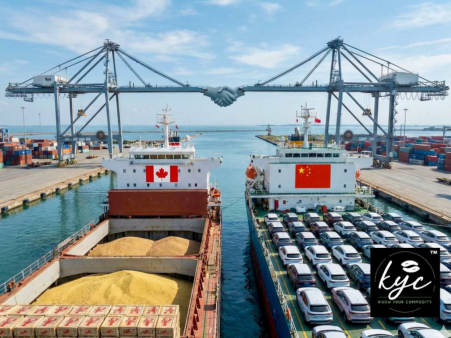
The preliminary agreement-in-principle reached between Canada and China on January 16, 2026, marks a watershed moment in global trade dynamics. This development, emerging from high- stakes dialogue between Prime Minister Mark Carney and President Xi Jinping, is less an embrace of ideological alignment and more a calculated exercise in economic survivalism. It represents a direct strategic pivot by Ottawa to insulate its economy from the volatility of U.S. protectionism under the Trump administration. The Electric Vehicle Compromise The most striking concession is Canada's recalibration on Chinese Electric Vehicles (EVs). Dropping the prohibitive 100% tariff to a Most-Favoured-Nation rate of 6.1% for a quota of 49,000 units is a masterclass in managed trade. By capping imports at pre-dispute levels, Canada protects its nascent domestic manufacturers from being flooded, while simultaneously keeping the door open for Chinese foreign direct investment (FDI). This move signals to Beijing that Canada is open for business in the EV supply chain, provided it translates into local capacity building over the next 3–5 years. It transforms a trade war weapon into a negotiation lever for industrial development. Agricultural Resurgence and Canola Diplomacy For the Canadian agriculture sector, this deal is a lifeline. The reduction of Canola seed tariffs from a suffocating 84-85% to roughly 15% is not merely an adjustment; it is the restoration of market viability. Canola has long been the primary casualty in Sino-Canadian diplomatic spats. The simultaneous removal of anti-discrimination tariffs on peas, lobsters, and crabs by March 1,
2026, will inject billions back into the rural Canadian economy. This effectively decouples Canadian farmers from the unpredictable "commodity weaponization" often seen in geopolitical disputes, offering stability where there was previously existential dread. Strategic Diversification The "Carney-Xi" accord must be viewed through the lens of diversification. With the U.S. erecting tariff walls, Canada—a nation whose economy historically relies on North American integration —is forced to hedge its bets. This limited, sector-specific agreement serves as a pilot program for a new independent trade policy. It is not a comprehensive Free Trade Agreement (FTA), but rather a functional "truce" that prioritizes economic pragmatism over diplomatic rigidity. Conclusion While preliminary, this agreement signifies a major reset. It acknowledges that in a multi-polar economic order, reliance on a single hegemon is a liability. By successfully navigating the sensitive domains of high-tech EVs and essential agriculture, Canada and China have established a blueprint for engagement that bypasses U.S. influence, setting the stage for potential expansions into energy and deeper agri-food cooperation.